An annual report is more than a compliance document. It’s a cornerstone of trust, a calling card and a strategic signal. But while demands are rising, bottlenecks can occur at a stage in the process that’s frequently underestimated: the path from approved data source to published online communication. With L·Sync, reporting teams take this final step back into their own hands – automated, secure and CI/CD-compliant.
Tuesday evening, shortly before the go-live of the online annual report: a key figure changes. Suddenly, several people are manually updating the PDF, microsite and website. Reporting teams know this situation – and how much is at stake.
Web-based, collaborative tools have significantly improved internal reporting processes and teamwork: data is managed centrally, approval workflows are structured and versions are controlled. But where these systems stop, the next problem begins. How do approved contents reach digital channels in a CI/CD-compliant way – error-free and with no media disruption?
This last mile – from approved data source to published online communication – remains a manual, error-prone effort for many companies today.
And there’s more: a static PDF no longer meets today’s standards. Stakeholders expect content that is mobile-accessible, interactive and measurable. Miss this step and you’ll end up missing your audience.
The three key weaknesses:
- Fragmented workflows: Isolated tools and missing synchronisation between source and online publication create extra effort and inconsistencies.
- Static formats: PDFs are structurally unable to meet the requirements of modern multi-channel communication.
- High risk of errors: Manual processes at the interface between system and channel are prone to error – with direct consequences for governance, compliance and reputation.
The solution: L·Sync as an intelligent control centre
L·Sync isn’t just another reporting tool. It’s a fundamentally new answer to a question that has remained unresolved until now: how can approved content be published automatically, consistently and channel-ready? This AI-powered solution connects existing source systems directly with digital output channels – without intervention, without media breaks, without deviations. This keeps control over content, timing and quality where it belongs: with the reporting team.
What sets L·Sync apart:
- Single source of truth: direct integration with all common systems (Microsoft Office, disclosure management systems, publishing and web tools).
- AI-powered transformation: approved content is automatically converted into digital formats.
- Automatic corporate-design compliance: PDF, microsite or website – everything stays consistent.
- Channel-optimised output: from comprehensive reporting to carefully curated content.
- No manual rework: changes can be managed in the source system right up to shortly before publication.
- Security: a GDPR-compliant, zero-trust-based platform – access is granted strictly on a need-to-know basis and via role-based permissions; data flows are end-to-end encrypted and run in highly secure, certified data centres with comprehensive monitoring and audit logs.
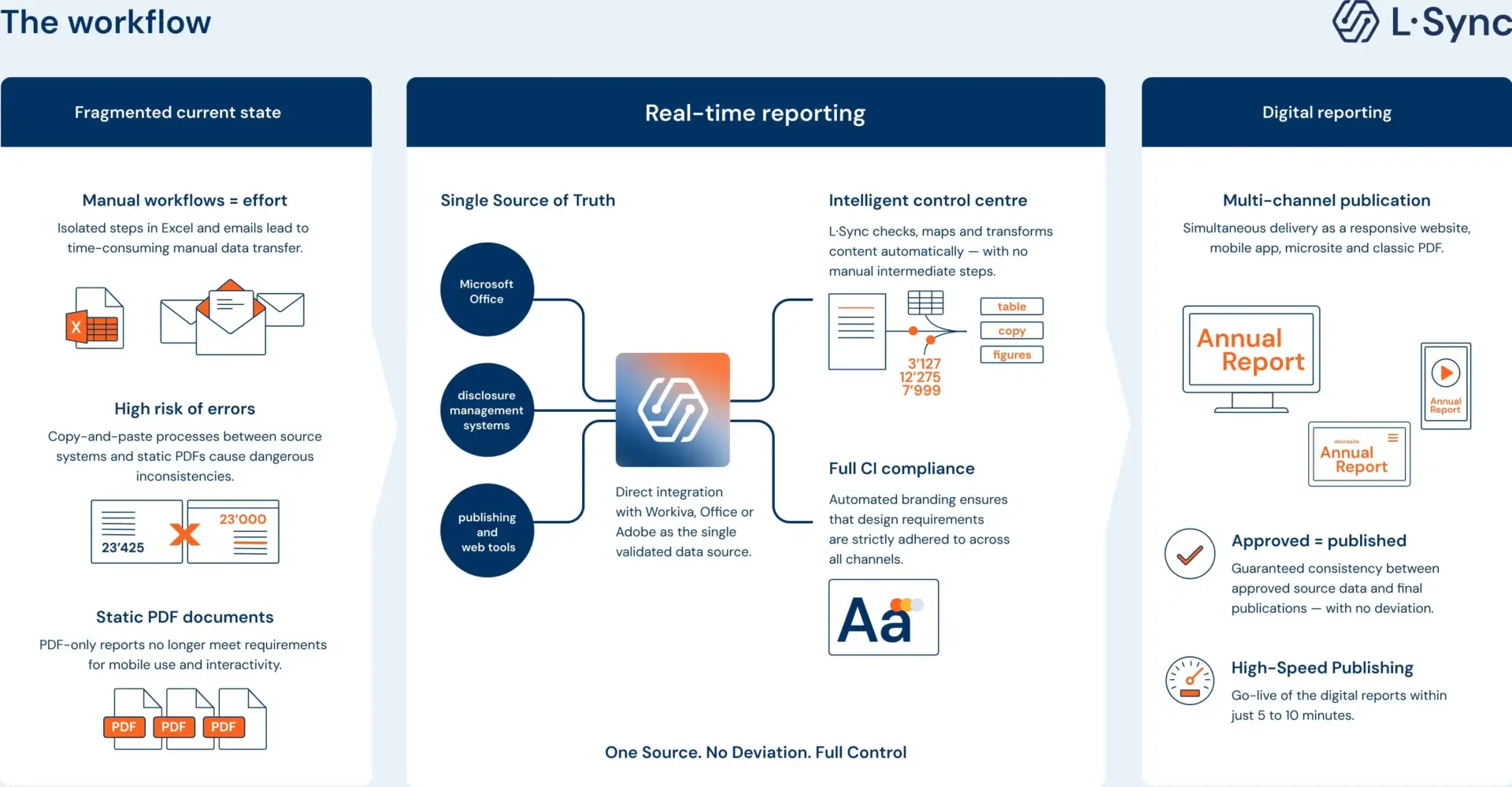
From one source to every channel
At the heart of L·Sync is the control layer: a central processing layer that receives content from source systems, validates it, maps it and transforms it for each channel.
The result is two clearly defined output paths:
- A complete online report for channels that require full coverage.
- Curated content for online formats where focus and overview are essential.
Both paths are based on the same source – with no deviations. One Source. No Deviation. Full Control. That means: maximum data security, no inconsistencies, and full transparency at every step.
Why this matters for decision-makers
For senior leaders, L·Sync is more than an operational simplification. It’s a strategic investment in the quality and credibility of their corporate communications.
- Data security: no manual intervention means no uncontrolled sources of error.
- Regulatory confidence: all published content is based on approved, verified data.
- Faster time-to-publish: automated processes significantly reduce turnaround times.
- Measurable impact: digital channels provide concrete data on reach and engagement.
- Scalability: from internal reports to listed-company reporting.
Conclusion
Reporting remains complex. Publishing it online doesn’t have to be. L·Sync eliminates the last-mile heavy lifting and turns it into a controlled, repeatable process. For reporting teams, that means: less risk, more flexibility, more control – and and no more Tuesday evenings spent manually updating the same figure across three different channels.
Book a consultation now and find out how L·Sync can transform your reporting process.
Q&A
From a regulatory standpoint, PDFs are still required. But for online audiences, they fall short. Stakeholders increasingly consume content digitally and on mobile devices. They expect interactivity, fast loading times and overview. A static PDF cannot structurally meet these expectations.
HTML doesn’t merely display content; it structures it so that tools like ChatGPT can reliably read, interpret and reproduce it. Texts, tables, KPIs, figures and interrelationships are semantically marked up, making them machine-interpretable. Connections become clearly recognisable – from hierarchies and KPI references to time periods and contextual information.
L·Sync connects directly to Microsoft Office, disclosure management systems, publishing and web tools – in other words, the very systems already in use across corporate reporting.
Thanks to the single source of truth, all output channels always work with the same approved data. Manual intervention is eliminated – along with the associated sources of error. This strengthens operational security, governance and compliance in equal measure.
L·Sync is designed to scale. The idea is to start with clearly defined pilot projects, with the option to extend step by step to more complex structures at any time.
With a single click, texts, images and charts can be selected and published directly via automated branding. Available options include a template library with various fully responsive modules, a bespoke template designed by Linkgroup, or API-based delivery into existing third-party systems.
Changes can be made in the source system until shortly before publication. L·Sync then automatically updates all channels – with no post-processing and no deviations.
For companies that see reporting as a strategic communication task – especially those that publish across multiple channels, operate under regulatory pressure or want to consolidate their publication processes.
For more information
Your contact
David Adlhoch
Communications consultant
T +41 44 268 12 06
david.adlhoch@linkgroup.ch